


Why claims and payment processing change management needs a new owner.
Summary
Claims processing automation speeds up how claims get paid, denied, or routed, but speed alone doesn’t protect a team when a regulator or auditor asks how a decision was made. This piece looks at why governing and testing every rule change is the real bottleneck claims and payment teams need to own, and how a governed decision platform removes it for good.
Key Takeaways
- Claims processing automation handles the operational decision (pay, deny, refer, route), but the harder, often-ignored decision is whether that outcome can be explained and reconstructed later.
- Claims rule sets accumulate complexity over years; testing changes against real historical volume, not sample cases, is what actually slows most teams down.
- Governance isn’t paperwork bolted on after a decision. It’s part of the decision itself: the rule, version, and approval chain need to be captured automatically, not reconstructed under pressure.
- Simulating rule changes against real production history proves a change is safe before it ships, replacing hope with evidence.
- A governed decision platform lets teams author, test, and prove claims rule changes safely, removing the change-management bottleneck without adding process.
Every claim that moves through a payer, a carrier, or a benefits administrator is really two decisions happening at once. The first is operational: pay it, deny it, refer it, or route it for review. Automated claims adjudication can make that operational decision faster, but the second decision is much bigger and far easier to ignore: someone, somewhere, just made a decision that an identifiable person can contest, that a regulator can ask about, and that may need to be reconstructed exactly as it stood months or years from now. Most organizations manage the first decision closely and the second one barely at all.
That gap is where insurance claims management and payment processing quietly become some of the highest-stakes categories of decision logic in the enterprise. They sit at the intersection of scale and scrutiny. Adjudication, first notice of loss, coordination of benefits, medical coding validation, prior authorization, exception routing: these are high volume by design and high consequence by nature. A pricing error is a bug. A health payer running tens of thousands of prior-authorization decisions a week can’t afford a rule change that quietly shifts approval rates overnight. A denied claim that cannot be explained to a regulator, an auditor, or the claimant themselves is a liability.
Why Claims Rule Testing Resists the Usual Playbook
The instinct in most organizations is to treat claims logic the way they treat any other business rule: build it, ship it, and only touch it again when something breaks or a regulation forces a change. That instinct breaks down here for two reasons.
First, the logic never stops accumulating. A claims rules engine built five years ago may have since absorbed new plan variations, new regulatory language, new fraud patterns, and new exceptions carved out for edge cases nobody wants to relitigate. By the time anyone asks to change it, no single person can say with confidence what else that change will touch.
Second, testing at the volume claims actually run at is not optional. A rule change that looks correct on a handful of sample cases can behave very differently once it meets the full breadth of real claim populations. Several organizations we talk with describe testing, not rule authoring, as the real bottleneck. Validation cycles stretch across days, not because the logic is hard to write, but because there is no reliable way to prove a change is safe before it ships.
That combination—rules too tangled to fully audit and testing too manual to keep pace—is why claims teams often end up choosing between speed and safety. Ship fast and hope nothing downstream breaks, or slow everything down and treat every change like a controlled burn.
Business Rules Governance Is Not the Paperwork After the Decision. It Is the Decision.
Here is the reframe worth sitting with: a claims decision is not truly finished the moment it pays or denies. It is finished when the organization can show, on demand, what rule fired, what version was active, who approved it, and what data it saw. Business rules governance is not an audit function bolted onto claims processing after the fact. It is part of the decision itself.
Most claims organizations build that proof reactively. Someone reconstructs it under pressure, usually after a regulator, an auditor, or an appeal has already asked the question. Effective claims decision governance turns that model around: the evidence behind the decision exists because governance was built into how the decision was managed in the first place. Manual reconstruction is expensive, slow, and never quite as convincing as a record that was there the whole time.
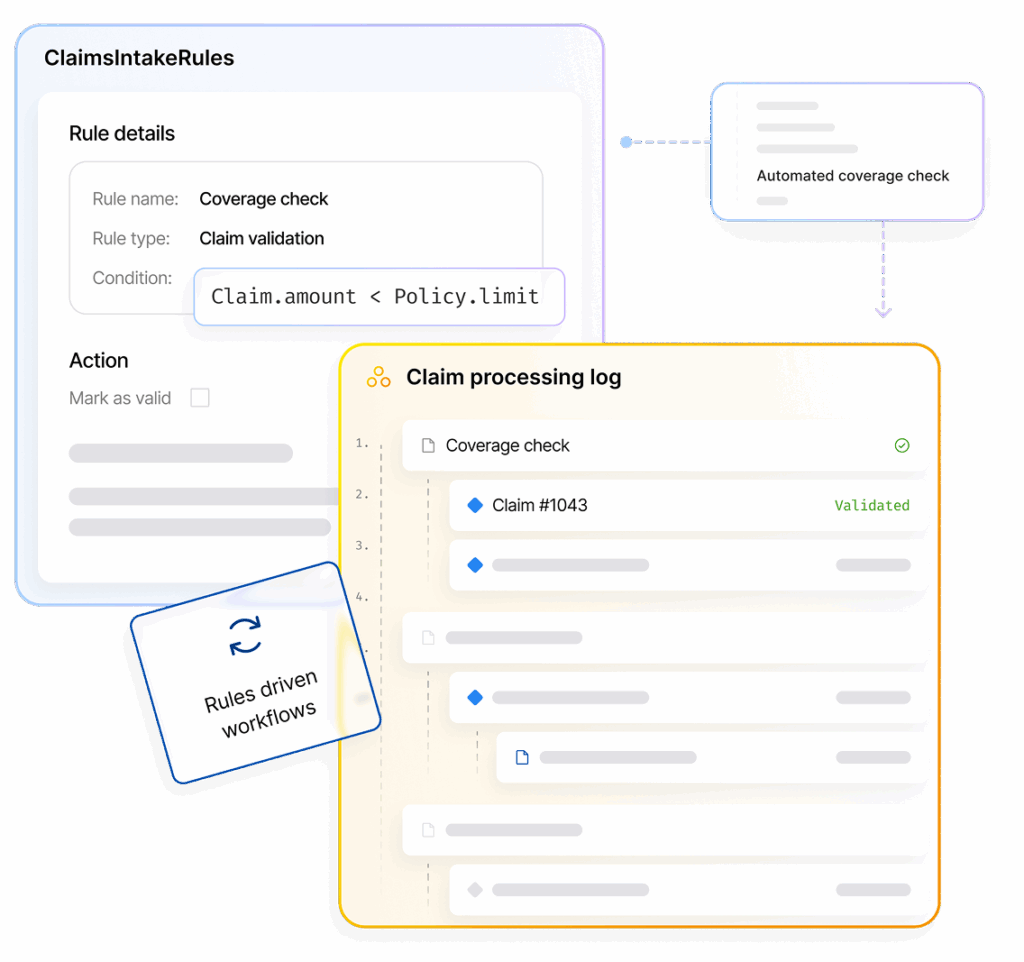
The alternative is to treat every claims decision as something that governs itself the instant it runs: the rule that fired, the version it ran against, the approval chain behind it, all captured automatically rather than assembled later from spreadsheets and email threads. When that claims audit trail already exists, an audit stops being an event and starts being a formality.
Claims Rule Simulation: Testing at the Volume the Business Actually Runs
The same logic applies to change. A claims rule set that has been running safely for years is not a reason to stop touching it; it is a reason to test every proposed change against the full weight of real production history before it goes live.
Claims rule simulation makes it possible to see how a proposed change would behave across thousands of historical claims, not a curated handful of samples. For teams asking how to test business rule changes before production, that distinction matters: testing against representative production history is the difference between hoping a change is safe and proving it.
This is the standard that regulated claims operations are increasingly expected to meet: not just accurate decisions, but decisions that can withstand scrutiny at any point after the fact, changed with confidence rather than dread.
Where This Leaves Claims and Payment Leaders
Claims and payment processing will keep growing more complex, not less. New products, new regulations, and new exception cases will keep layering on top of what already exists. The organizations that will handle that complexity well are not the ones that freeze their rule sets out of fear. They are the ones that build governance and testing into how the decision runs in the first place, so that every future change is something they can prove was safe, rather than something they simply hope was.
That shift—from governance as an afterthought to governance as a byproduct of execution—is the real work ahead for anyone responsible for how claims get decided.
None of this requires waiting for a better developer, a bigger IT budget, or a slower quarter. It requires a different kind of platform underneath the work; one built specifically to govern decisions rather than simply execute them. With claims processing automation built on a governed decision platform, teams can author and simulate changes directly, prove each one safe against real production history before it ships, and keep the record of what changed and why without anyone having to assemble it later. If the change cycle described here sounds familiar, the fix isn’t more process. It’s a platform that was built to remove the bottleneck in the first place.
FAQs
What is claims processing automation?
Claims processing automation uses decision logic to determine how claims should be paid, denied, referred, or routed for review. In regulated claims environments, automation also needs governance so teams can show what rule produced an outcome, which version was active, and how that decision was approved.
How does automated claims adjudication work?
Automated claims adjudication applies defined decision logic to claim information to determine an operational outcome, such as paying, denying, referring, or routing a claim for review. A governed approach also preserves the rule, version, data, and approval history behind that outcome so the decision can be reconstructed later.
How do you test claims rule changes before they go live?
Teams can test claims rules before production by simulating proposed changes against historical claim populations rather than relying only on a small set of sample cases. This allows teams to see how changed logic would behave across real production history and establish evidence that a change is safe before it ships.
What is a claims audit trail, and why does it matter for compliance?
A claims audit trail records the logic behind a claims decision, including the rule that fired, the version that ran, and the approval chain behind it. Capturing that information as the decision runs makes it possible to reconstruct and explain an outcome later without piecing together evidence from spreadsheets, emails, and other records.