


Google. Anthropic. Meta. OpenAI. xAI. Nvidia. Six companies just signed on to govern their models.
Notice what’s missing: anything about what you build on top of them.
The companies building the most powerful models on earth just agreed, formally, that their responsibility stops at the model. Everyone building on top of it inherits the rest.
Gartner’s published analysis, First Take: White House AI Accord Shifts Liability to Enterprises and Providers, called it correctly: “The agreement takes a nongovernmental approach to addressing safety, security and transparency concerns beyond just LLMs, and shifts liability, costs and accountability to the solutions developed by adopter organizations and products/services purchased from technology providers.”
The gap was always there. Now it’s in writing.
For a few years, enterprises got comfortable outsourcing their safety thinking: pick a reputable model, trust its training, inherit its judgment. That instinct was always a little too convenient. Now it’s explicitly wrong.
A frontier lab’s internal controls tell you how a model was trained. They tell you nothing about how your underwriting engine used it to deny a claim. Nothing about how your pricing logic used it to set a rate. Nothing about how your eligibility system used it to turn someone away. Those are your decisions. Made with your data, inside your process. No amount of upstream safety work transfers the accountability for them.
Governance is the only thing built to carry that weight
If the decision is yours, the only real move is to make the decision governable. That comes down to a few things, none of which are new ideas, all of which just got more urgent.
Start with how the decision gets made in the first place. A system that lets a model infer its way to an outcome, case by case, is a system nobody can fully predict or explain and “the model decided” is not an answer that survives contact with a regulator. The logic driving a decision has to be something a person authored, reviewed, and can stand behind: explicit rules, explicit thresholds, explicit exceptions, not a probability distribution dressed up as a verdict. That doesn’t mean AI has no role. It means AI should inform a decision inside a structure that constrains what it’s allowed to do, rather than hand it an open-ended mandate and hope for the best.
See governed decision-making in action
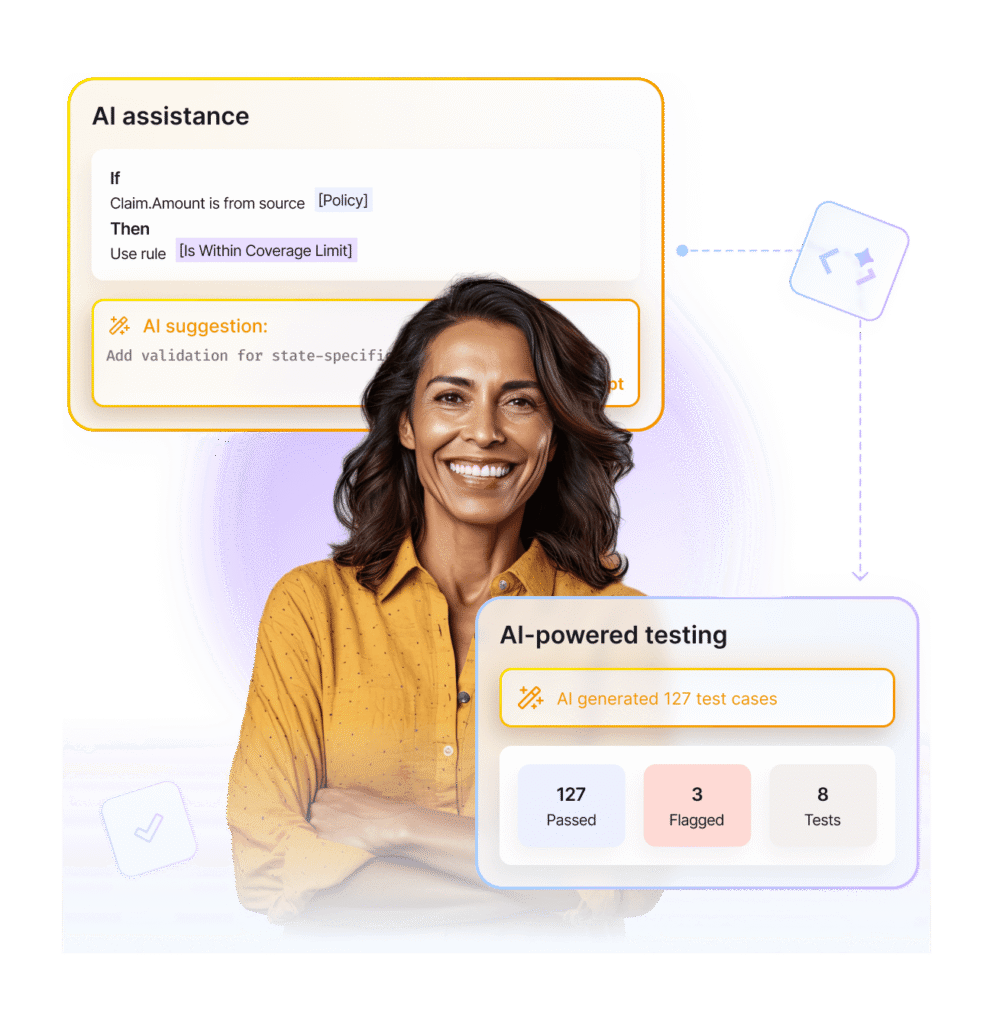
Explore InRule’s AI capabilities and see how your team can author, test, and explain the rules behind business decisions.

Then there’s the record. Every decision needs a trail you can reconstruct on demand: what ran, what data it touched, which rule or policy drove the outcome. A transcript of a model’s reasoning doesn’t reliably give you that since reasoning isn’t the same as a rule, and it isn’t guaranteed to reproduce the same way twice. What you need is closer to a flight recorder than a chat log: a clear, stable account of cause and effect that holds up under scrutiny.
That record only matters if it survives change. Decisioning logic doesn’t sit still. It gets updated, retrained, retuned, patched. If you can’t reconstruct exactly what was running on the day a disputed decision happened, your audit trail is theoretical. Version control over the logic itself, not just the output, is what makes “we can show our work” true a year from now instead of just true today.
None of this has to happen in isolation, either. The same instinct that’s pushing enterprises toward internal governance is pushing the broader market toward external validation. Insurers pricing AI liability, auditors building practices around it, standards bodies starting to define what “well-governed” actually looks like. That ecosystem is still young, but it’s the direction things are heading, and it rewards exactly the kind of system that can produce a clean answer when someone outside the company asks a hard question. It’s also worth revisiting what your contracts actually promise. A lot of indemnification language was written before anyone was deploying models into live business decisions, and it’s worth checking whether it still reflects where the risk actually sits now.
The real takeaway
Letting frontier labs own model safety was never going to cover the thousands of enterprises building on top of them. If your AI strategy has been leaning on “we use a safety-conscious provider” as a stand-in for governing your own decisions, close that gap now. Not because a voluntary commitment demands it. Because nothing else will defend you when it actually matters.
Put AI governance into practice
Bring accountability to the decisions behind claims and processing. Explore how InRule combines AI, business rules, and decision automation to support transparent, explainable outcomes.
